Shopping from our consignment selection is a great way to save money on your equestrian gear and supplies while supporting the local horse community.
At The Trainer’s Loft every one of our consigned goods is individually inspected to ensure its quality and safety. Search for specific gear or browse our wide collection of available items. For more information contact The Trainers Loft at 603-729-0018:
Showing 689–704 of 2215 resultsSorted by popularity
The Dr. Cook® Beta Bitless Bridle was developed by Dr. Robert Cook after years of research, inspiration, and perspiration! The Dr. Cook® Bitless Bridles are marketed all over the world and used in all disciplines. It is the most accepted and trusted ‘bit free’ bridle on the market. The Bitless Bridle allows the rider gentle, effective control and clear communication with painless pressure that is distributed around the whole of the horse’s head. Made from beta, a leather-like synthetic material that is composed of a nylon core with a vinyl coating, this bridle is impervious to dirt and sweat and will give you years of use with no maintenance required.
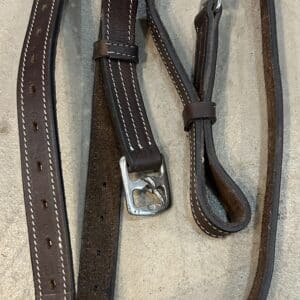
Pair of Havana brown leather stirrup straps with light colored stitching, 36″ long x 1″ wide. Comes with a keeper strap on each, numbered holes (18), and silver buckles.
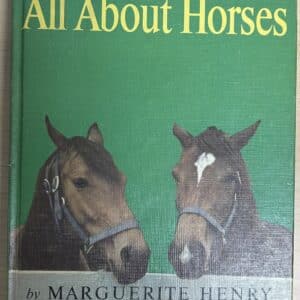
An illustrated survey of horses in history encompassing: the prehistoric horse; the domesticated horse; the horse in war, legend, transportation, and art; and horse breeds.
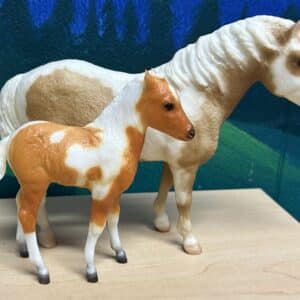
The Misty mold is a portrait model of the horse made famous in Marguerite Henry’s book Misty of Chincoteague. The mold has both the round “Breyer Molding Co.” and “U.S.A.” mold stamps, and occasionally the “B” stamp as well. First introduced in 1972, she has been in production ever since. Misty was sculpted by Chris Hess and is Breyer mold #20.
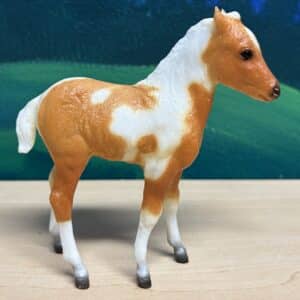
The Stormy mold was introduced in 1977 and is named for the equine star of Marguerite Henry’s book Stormy, Misty’s Foal. The mold has the round “Breyer Molding Co.” mold stamp, and it’s possible that some may have the “B” stamp as well. Stormy was sculpted by Chris Hess and is Breyer mold #19.
Select options
This product has multiple variants. The options may be chosen on the product page
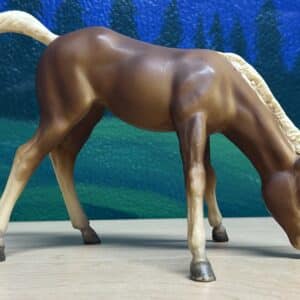
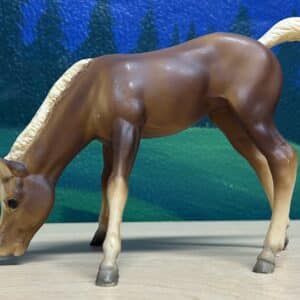
The Grazing Foal was introduced in 1965 with only the round “Breyer Molding Co.” stamp. Sometime around 1970 the “U.S.A.” stamp was added, and some of the also have the “B” stamp. It was sculpted by Chris Hess and is Breyer mold #151.
Select options
This product has multiple variants. The options may be chosen on the product page
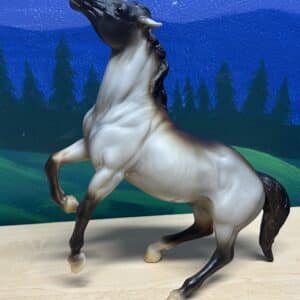
The Semi-Rearing Mustang (or Mustang) mold was introduced in 1961 with the round “Breyer Molding Co.” mold stamp, with later (post 1970) models adding the “U.S.A.” stamp. Many early models also had the tip of the the near front hoof cut flat, probably to help stabilize the model. The model was sculpted by Chris Hess and is Breyer mold #87.
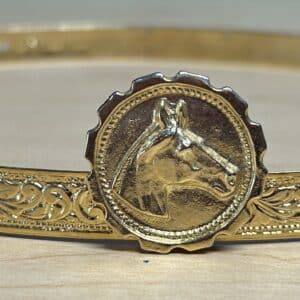
Golden Metal Western Hatband with Horsehead Medallion
Beautiful and shiny, this adjustable golden metal western hatband is sure to elevate your western hat with refined style! The band has a lovely leaves and flourishes, millgrain bordering, and a classic golden horsehead medallion surrounded by millgrain detailing as well.
This metal hatband has 5 size slots that allow for fine adjustability (~2″), allowing the inner circumference to measure between approx. 22.5″ – 24.5″. The round horsehead medallion is 1.25″ tall.
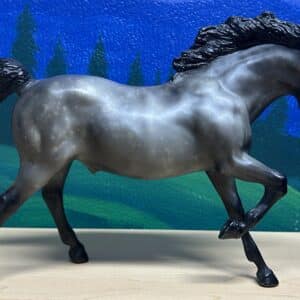
This Running Stallion model is a beautiful matte and semigloss dark dapple grey, with solid face, and black mane and tail. The stallion’s body shade varies from medium dark grey to nearly black, both matching its name, Rumbling Thunder, and the stormy skies one would see with an incoming thunderstorm.
Rumbling Thunder is model #879, and was released during 1993-1994.
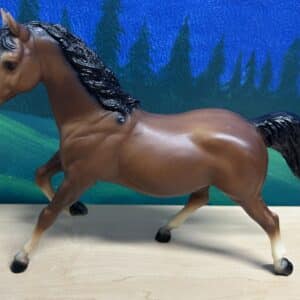
The Running Mare was introduced in about 1961 with only the round “Breyer Molding Co.” mold stamp. In 1970 the “U.S.A.” stamp was added, and some of these also have the “B” stamp. Beginning in 1983 or 1984 and running through 1993 the mold had a flattened off (right) side eye, with less definition to the corner of the cheekbone as well. In 1994 this flat eye was fixed, although the area around the eye remains flawed. The 1994 eye is larger and sticks out more than pre-1983 models. The Running Mare was sculpted by Chris Hess and is Breyer mold #120.
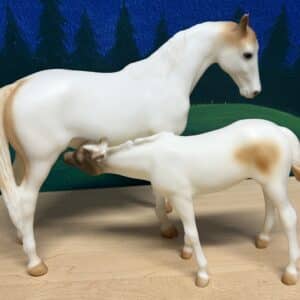
The Thoroughbred Mare was introduced in 1973 and has the round “Breyer Molding Co.” and “U.S.A.” mold stamps, and some may have the “B” stamp as well. The mold was sculpted by Chris Hess and is Breyer mold #3155MA.
The Suckling Foal, also called the Nursing Foal, was introduced in 1973 and is designed to nurse from the Thoroughbred Mare. It has the round “Breyer Molding Co.” and the “U.S.A.” mold stamps, and some models may also have the “B” stamp. The mold was sculpted by Chris Hess and is Breyer mold #3155FO.
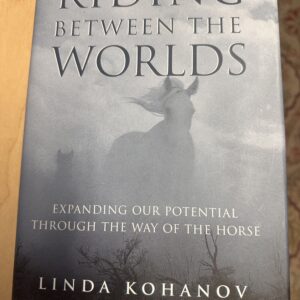
In this powerful follow-up to her groundbreaking work The Tao of Equus, Linda Kohanov introduces provocative new theories about the human-horse connection, theories supported by in-depth experience. “Horses,” she maintains, “model an embodied spirituality, one that is both fully present in this world and deeply connected to the soul’s divine origins.” Kohanov explores how these animals support us on both levels, leading us to unexpected realizations about fear, intuition, awareness, empowerment, and above all, authenticity.
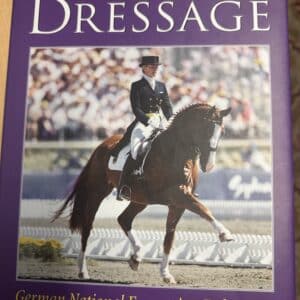
Advanced Techniques of Dressage, German National Equestrian Federation
Translated from the official instruction handbook of the German National Equestrian Federation, this teaching manual provides an instruction course in advanced level dressage for horse and rider. Using the German training system – a clear and logical system that has consistently produced international champions for many decades – the manual describes in detail the criteria governing each stage of dressage training – from transitions and extensions to piaffe and passage – giving the aids and training methods to be used for each movement or exercise. Respecting both purity and classical traditions, its aim is to create true harmony between rider and horse, and therefore mutual trust and confidence.
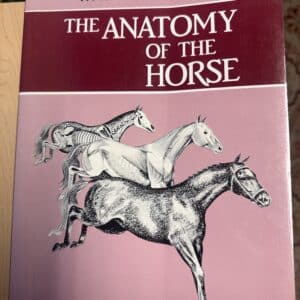
“The Anatomy of the Horse” by Robert Way and Donald Lee is a comprehensive book on the topic of horses, focusing on their anatomy. Published in 1965 by Blackwell Scientific Publications in the United Kingdom. Written in English, this original work offers a detailed exploration of the horses’ physical structure, making it a valuable resource for horse enthusiasts and professionals alike.
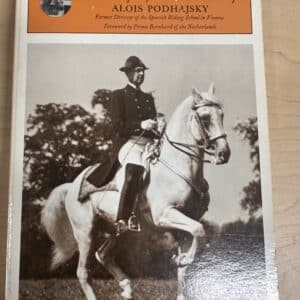
Complete Training of Horse and Rider in the Principles of Classical Horsemanship, Alois Podhajsky
For over a quarter of a century, Colonel Alois Podhajsky was the Director of the Spanish Riding School in Vienna, home of the famous white Lipizzaner stallions whose remarkable performances have thrilled audiences throughout the world. Now for the first time, Col. Podhajsky has set forth explicitly and in practical, instructive fashion the step-by-step methods of training both horse and rider that are used at the School and that are the applicable foundations of all good horsemanship, for their purpose is to develop the natural abilities of the horse and to make riding a graceful, pleasurable experience.